
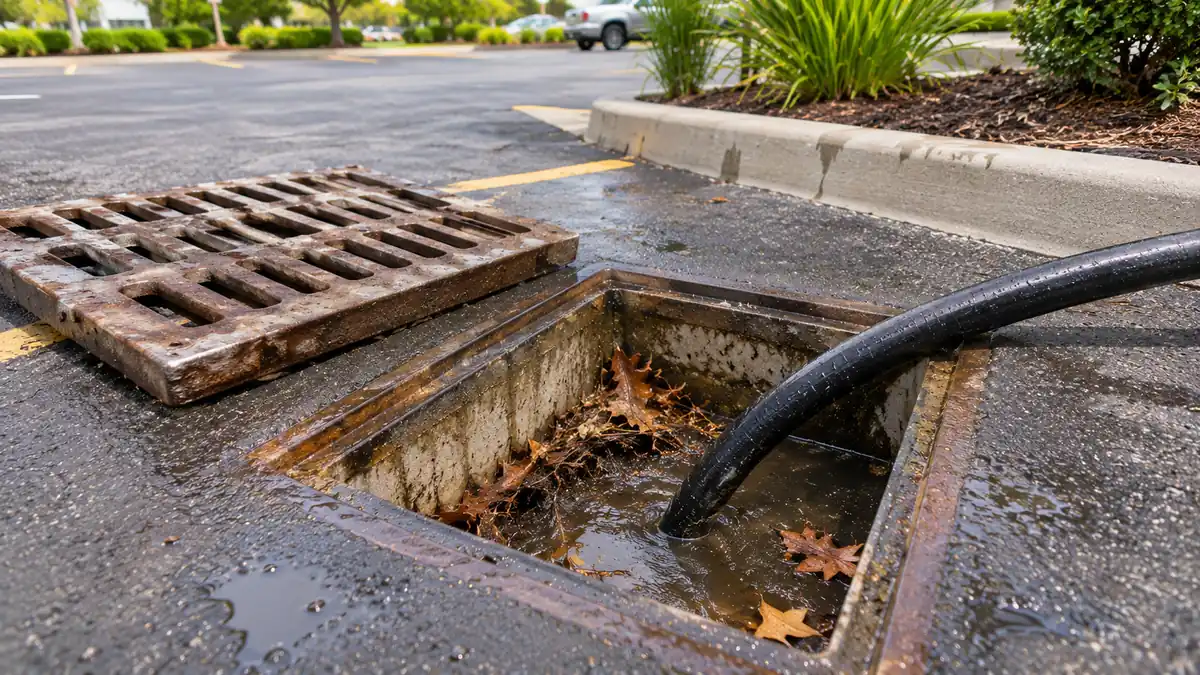
What clogs storm drains?
Storm drains clog with whatever rain washes off hard surfaces. The U.S. EPA describes runoff from paved streets, parking lots and rooftops picking up trash, chemicals, oils and dirt or sediment. Over time that load settles in catch basins and pipes until water backs up.
- Sediment and sand: the biggest source of buildup in most catch basins
- Leaves and grass clippings: mat together and block grates and pipes
- Trash: cups, bags and packaging from parking lots
- Roots: enter older storm pipes through joints, just like sewer lines
- Oil and grime: coat the inside of the pipe in busy lots
If your lot or yard holds water long after the rain stops, the drain is likely filling up. Call now to get information about the service and book a cleaning.
Storm drain vs sanitary sewer: what is the difference?
They are separate systems. Sanitary sewers carry wastewater to treatment. Storm drains carry rainwater, and EPA notes that municipal storm sewer systems often discharge it untreated into local waterways. That difference shapes how storm drains should be cleaned.
| Question | Storm drain | Sanitary sewer |
|---|---|---|
| What it carries | Rain and melted snow from streets, lots and roofs | Wastewater from toilets, sinks, showers |
| Where it goes | Often straight to creeks, rivers, lakes or the ocean | Treatment plant or septic system |
| Typical clog | Sediment, leaves, trash | Grease, wipes, roots |
| Cleaning approach | Jetting and vacuum recovery, often used together | Jet debris toward the sewer main |
Storm drain jetting vs vacuum cleaning
The two usually work as a team. Vacuum equipment lifts the heavy sediment out of the catch basin. Jetting loosens the compacted material inside the pipes and pulls it back to the basin, where it can be vacuumed out instead of being washed downstream.
That capture step matters for storm systems because the water leaving them is often not treated. The job should be planned to capture and properly handle the removed sediment and debris, in line with local requirements. Ask on the call how debris will be handled for your property, and book a visit when you are ready.
What is catch basin cleaning?
Catch basin cleaning empties the settling box under a storm drain grate. The basin's sump is designed to trap sand and debris; when it fills, debris flows into the pipe and the system floods. Cleaning restores the space the sump needs to do its job.
A typical visit lifts the grate, vacuums out the sediment and trash, jets the outlet pipe if it is slow, and checks the basin walls and grate for damage. Properties with several basins often have them cleaned on a schedule. Call to ask about a schedule that fits your site.
Residential storm drain cleaning
Many homes have their own small storm system: yard drains, area drains in low spots, and downspout lines buried in the lawn. They clog with leaves, roots and soil, and water then pools against the foundation or across the driveway.
These lines are smaller than commercial storm pipes, so pros use lighter jetting equipment, similar to drain jetting inside the house. If a downspout overflows or a yard drain stays full after rain, call and describe where the water collects. A local pro can explain the options and book your service.
Who needs storm drain cleaning?
Anyone who owns or manages paved areas with their own drains. Public street drains are usually handled by the city, but private lots and yards are the owner's to maintain.
- Shopping centers, offices and warehouses with parking lots
- HOAs, apartment complexes and condo associations
- Schools, churches and hospitals
- Restaurants and gas stations with busy lots (see commercial grease jetting for kitchen lines)
- Homeowners with yard drains or buried downspout lines
How do you keep storm drains flowing?
Most storm drain problems start on the surface, so the best prevention happens above ground: keep debris away from inlets and catch sediment before it reaches the pipes.
- Sweep lots and keep leaves and clippings away from grates
- Check catch basins before the rainy season and after big storms
- Never wash oil, paint or chemicals into a storm drain
- Fix broken grates and damaged basin walls quickly
- Book a camera check if a drain floods even after cleaning
Storm drain cleaning near you
Searching for storm drain cleaning near me? Local professionals offer storm drain and catch basin cleaning for homes, HOAs and businesses across the country. Each city page covers local rainfall, soil and drainage conditions.
Local pages: Stockton, CA · Newark, NJ · Riverside, CA · Irvine, CA · Corpus Christi, TX · Santa Ana, CA · Cincinnati, OH · Greensboro, NC
All states and cities are on the areas we serve page. Calls are answered 24/7.