
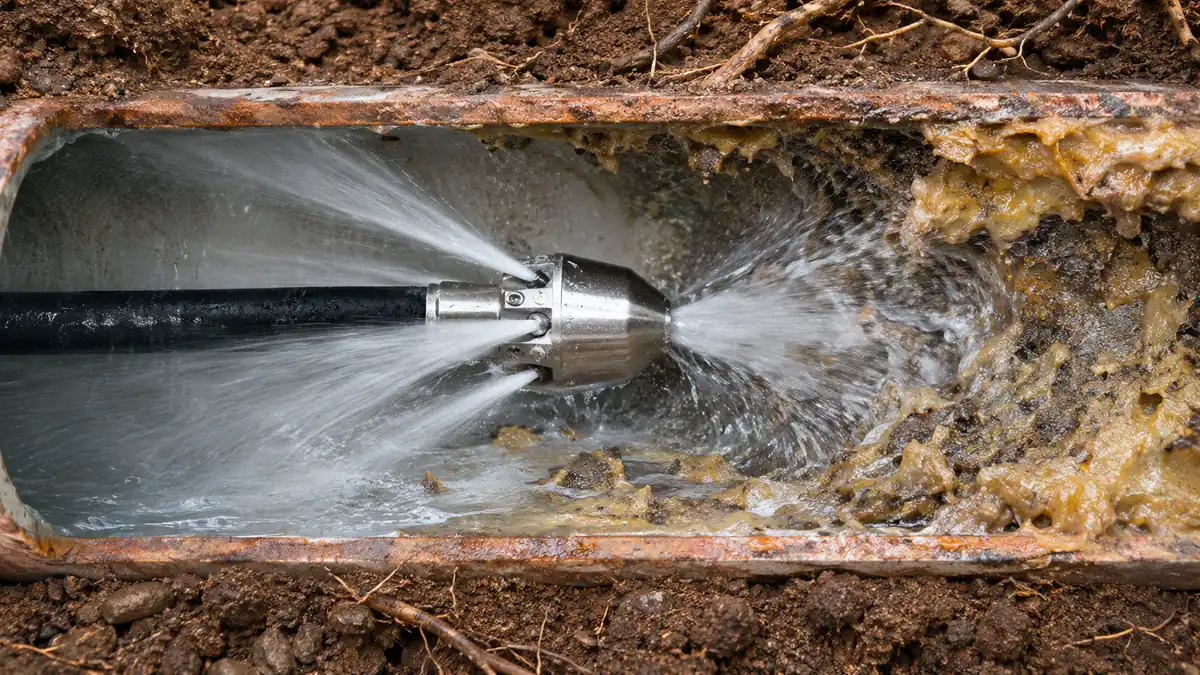
What is sewer line jetting?
Sewer line jetting is hydro jetting for the main line, also called the building sewer or lateral. Every sink, tub, toilet and washer drains into this one pipe, so when it narrows, the whole building feels it. A jetter cleans the pipe from the cleanout to the street sewer or septic tank.
Home sewer lines are typically about 4 inches across, and commercial lines are often larger. That larger size needs a heavier hose, more water flow and a different nozzle than the small drain jetting used on a single sink. People search for it as sewer jetting, sewer line cleaning, sewer drain cleaning service or sewer cleaning near me. It is the same main-line service.
If several drains are slow at once, the main line is the likely cause. Call now to talk to a local sewer jetting pro.
How do you know the main sewer line is clogged?
The giveaway is that the problem shows up in more than one place. Water backs up into the lowest drain in the house, usually a basement floor drain, shower or tub, when a toilet is flushed or the washer empties. One slow sink on its own is rarely a main line problem.
- Two or more fixtures drain slowly at the same time
- Flushing a toilet makes water rise or gurgle in the tub or shower
- Sewage smell near floor drains or the yard cleanout
- Water seeping out of the cleanout cap
- The main line has needed snaking more than once in a year
EPA lists blockages among the possible causes of sewer overflows, which can back up into homes, damage property and threaten health. If water is already coming up, see sewer backup and main line clogs and call now. Calls answered 24/7.
How is a sewer line jetted?
The job follows a set order: find access, check the line, jet it, then confirm it is clear. Many pros run a camera before and after, so you see what was in the pipe and what it looks like when done.
- Access. The pro opens the main cleanout, usually outside near the foundation or in a basement.
- Look first. On older lines a sewer camera inspection shows the blockage, the pipe material and any damage.
- Jet. A nozzle chosen for the problem (grease, sludge, roots) is fed in. Its rear jets create thrust that propels it up the line, scrubbing the walls while debris washes downstream.
- Confirm. Running water through the line, or a second camera pass, confirms it flows freely.
Want to know how long your job will take? Ask the pro when you call.
Is sewer jetting safe for clay, cast iron, PVC and Orangeburg pipes?
Most sewer pipes in sound condition can be jetted safely when the nozzle and pressure suit the pipe. The risk depends on the material and its age. A camera inspection is the honest way to know before jetting an older line.
| Pipe material | Where you find it | Jetting notes |
|---|---|---|
| PVC / ABS plastic | Newer homes and replaced lines | Handles jetting well; smooth walls clean easily |
| Cast iron | Older homes, under slabs | Usually fine; heavy rust or cracks need a camera check first |
| Vitrified clay | Older laterals, often outdoors | Commonly jetted; joints let roots in, so root nozzles are used |
| Concrete | Older and larger lines | Can be jetted; worn or crumbling sections need care |
| Orangeburg (fiber pipe) | Laterals installed roughly 1940 to 1970 | Fragile; tends to deform over time, so a camera check is strongly advised |
Orangeburg pipe was made from pitch-pressed wood pulp and was used for many house-to-street sewer connections in the mid-1900s. Trade reporting notes it tends to deform under the weight of soil over long periods. If your home was built in that era and you do not know the pipe material, ask about a camera check on the call.
What are the pros and cons of hydro jetting a sewer line?
The main advantage is a cleaner pipe that stays open longer than after snaking. The main drawbacks are that it costs more than a basic snake and it is not a fix for broken or sagging pipe. A camera check helps decide which applies.
| Pros | Cons |
|---|---|
| Scours grease, sludge and scale off the walls | Usually costs more than snaking alone |
| Can cut and flush roots with the right nozzle | Roots return if the cracked joint is not repaired |
| Uses only water, no harsh drain chemicals | Fragile old pipe needs a camera check first |
| Clogs often take longer to come back | Cannot fix a belly, break or collapse |
Want to know which side applies to your line? Call and talk it through with a local pro.
Why a camera inspection often comes first
A camera shows what jetting cannot fix. If the line has a belly, a break or a collapsed section, jetting may clear it for a short time but the clogs will come back. Knowing that before the job saves you from paying to clean a pipe that needs repair.
The City of San Diego advises owners that older concrete, clay or cast iron laterals may have root intrusion or deteriorated sections and need regular inspection. A camera run also tells the pro which nozzle to use and how far the blockage is from the cleanout. Ask for a camera check when you call if your line is old or has clogged before.
How often should sewer lines be cleaned?
There is no single schedule. The City of San Diego notes that the right maintenance depends on the lateral's age and material and on how the building is used. Newer plastic lines with tight joints may go years without trouble, while older clay or cast iron lines with roots may need cleaning more often.
A practical approach many owners use:
- No problems, newer plastic line: clean only when symptoms appear
- Older clay or cast iron with a history of roots: regular cleaning, with timing based on how fast roots return on camera
- Restaurants and other heavy grease users: a set maintenance schedule, see commercial grease line jetting
The pro can suggest a schedule after seeing your line. Call now to book your service or ask what makes sense for your home.
How to prevent repeat sewer clogs
Most repeat main line clogs come from grease, wipes and roots. The U.S. EPA names grease and tree roots as the primary causes of sewer blockages, so controlling those two does the most good.
- Pour cooking grease into a container, not the sink
- Flush only toilet paper; "flushable" wipes still catch in sewer lines
- Know where your cleanout is and keep it accessible
- Plant trees away from the sewer line where you can
- Repair the cracked or offset joints that let roots in; jetting clears roots but does not repair the pipe
When clogs keep coming back despite good habits, call to ask about a camera check and book your service.
Sewer line jetting near you
Sewer line jetting is available through local professionals nationwide. City pages describe local factors such as the age of the housing, soil and the trees that most often cause root problems.
Local pages: Denver, CO · Nashville, TN · Oklahoma City, OK · El Paso, TX · Las Vegas, NV · Boston, MA · Detroit, MI · Louisville, KY
All states and cities are on the areas we serve page. Calls are answered 24/7 from anywhere in the country.