
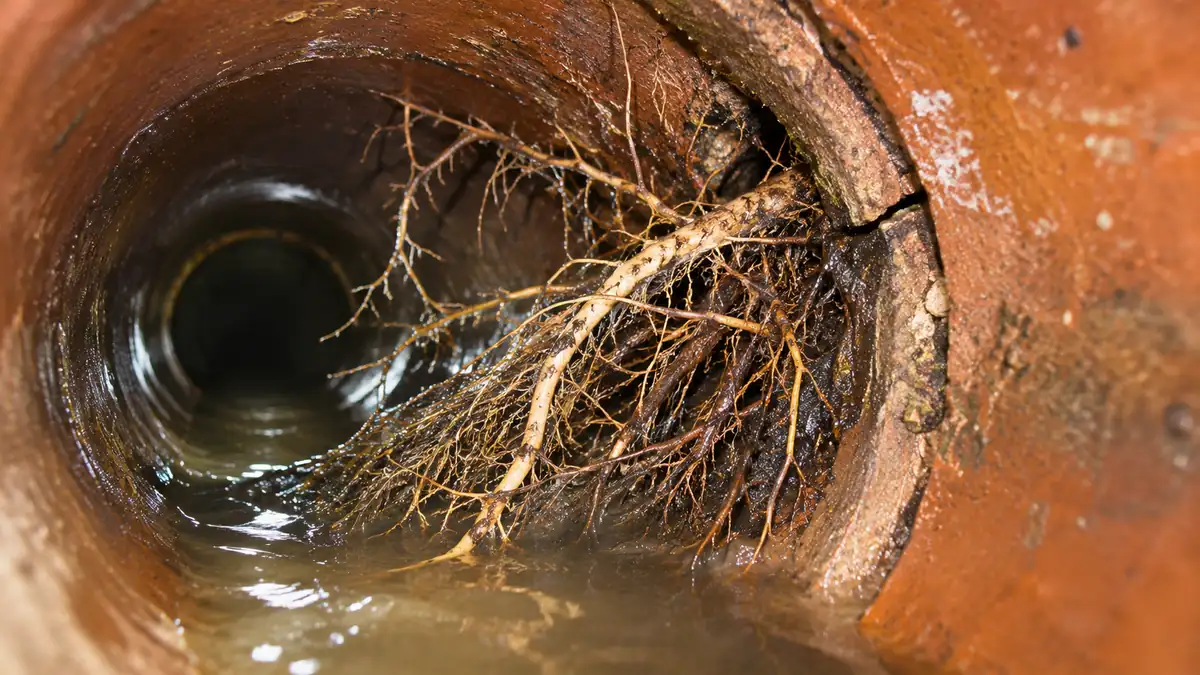
How do tree roots get into sewer lines?
Roots look for water and nutrients. Los Angeles County Public Works explains that roots usually grow over and around a sewer lateral without harm, but if the pipe has a leak, no matter how small, tiny hair-like roots enter and grow quickly on the nutrient-rich flow inside.
Older pipes are the most likely to have those small openings. Clay sewer pipe comes in short sections joined every few feet, and each joint is a possible entry point as the ground shifts. Cracked cast iron and failing Orangeburg pipe give roots the same chance. Once inside, roots can form a net that catches paper and grease and gradually narrows the line.
The U.S. EPA inspection manual states that grease and tree roots are the primary causes of sewer blockages, so roots are not a rare problem. If you have big trees near the sewer line and slow drains, call and talk to a local pro about checking it.
What are the signs of roots in a sewer line?
Root clogs look like any main line clog at first, but they have a pattern: they come back. Drains slow down across the house, the line gets cleared, and a few weeks or months later the same thing happens, often worse in warm months when trees grow fastest.
- Several drains slow down at the same time, not just one sink
- Gurgling toilets or bubbles in the tub when other fixtures drain
- A main line that has needed clearing more than once in a year
- Wet or unusually green patches over the sewer line in the yard
- Large trees or shrubs planted near the path of the sewer pipe
Seeing two or more of these? Call now. A local pro can explain how roots are confirmed and book your service.
How are roots removed from a sewer line?
Most root jobs combine three steps: look, cut, clean. A camera finds the roots and the pipe condition, a cutting tool or root nozzle removes them, and hydro jetting washes the pieces and the debris they trapped out of the line.
| Method | What it does | Limits |
|---|---|---|
| Root-cutting jet nozzle | Slices fine and medium roots and flushes them out | Very thick roots may need a mechanical cutter first |
| Mechanical root cutter (cable machine) | Saws through dense root masses | Leaves fragments and debris on the walls |
| Hydro jetting after cutting | Cleans what is left, restores flow | Does not seal the entry point |
| Chemical root treatment | May slow regrowth | Does not clear a packed line or fix the pipe |
| Pipe repair or lining | Closes the crack or joint roots used | Bigger job; usually chosen after a camera inspection |
Jetting after cutting helps remove root pieces and debris a cable can leave behind. How long the result lasts still depends on the crack or joint the roots came through. See sewer line jetting for how the main line is cleaned.
Why don't root killers alone fix the problem?
A root killer works on roots it touches, but a pipe already packed with roots needs them physically removed so water can flow. Even after roots die back, the crack or loose joint that let them in is still there, so new roots can follow.
That is why most pros treat chemicals as an add-on at best. The lasting answer is clearing the line and dealing with the opening. If your line has been treated before and still clogs, a sewer camera inspection shows what is happening at the entry point. Call to ask whether a camera check makes sense.
How do you keep roots out after removal?
Keeping roots out means closing the gaps they use and watching the line. Los Angeles County asks homeowners to maintain the integrity of the lateral to prevent root intrusion, because a sealed pipe gives roots nothing to enter.
- Repair or line the cracked or offset joints the camera finds
- Schedule follow-up cleaning based on how fast your line regrows
- Plant new trees and large shrubs away from the sewer path
- Keep grease and wipes out of drains, so smaller root hairs catch less debris
- Know where your cleanout is so the line can be reached quickly
Want a schedule that fits your trees and pipe? Call and book a visit with a local pro.
When does a pipe need more than root cleaning?
If the camera shows a crushed section, a separated joint, a belly that holds water or roots that keep returning within a short time, cleaning alone will not stop the problem. At that point the pipe itself needs repair.
Cleaning still has a role: it opens the line so it can be inspected and keeps it working while a repair is planned. If water is already backing up, see sewer backup and main line clogs and call now. Calls are answered 24/7.
Tree root removal near you
Root problems are most common where older clay or cast iron sewer lines run near mature trees. Local professionals offer root removal across the country, and each city page covers local trees, soil and housing age.
Local pages: Portland, OR · Memphis, TN · Baltimore, MD · Milwaukee, WI · Albuquerque, NM · Fresno, CA · Tucson, AZ · Sacramento, CA
Find every state and city on the areas we serve page, or call from anywhere. Calls are answered 24/7.