
What is hydro jetting in plumbing?
In plumbing, hydro jetting means cleaning the inside of a drain or sewer pipe with a focused stream of high-pressure water. It is used on kitchen and floor drains, main sewer lines, restaurant grease lines and storm drains. The goal is to remove buildup from the pipe walls, not just open a path through the blockage.
The method grew out of municipal sewer cleaning, where large truck-mounted jetters keep public mains flowing. Smaller trailer and cart jetters brought the same idea to homes and businesses. Today it is commonly used for drain and sewer lines that keep clogging because of buildup. You will also hear it called water jetting, sewer jetting, high-pressure drain cleaning or hydrojet drain cleaning.
How does hydro jetting work?
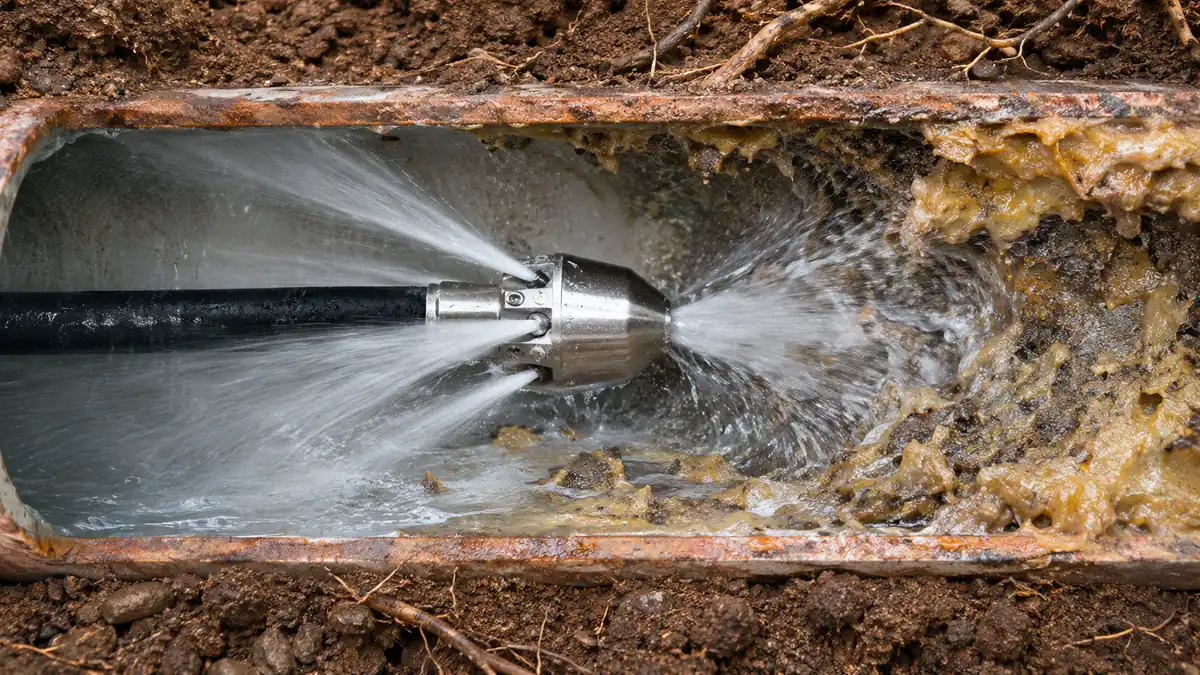
A jetter has three working parts: a pump that pressurizes water, a long high-pressure hose on a reel, and a nozzle at the end of the hose. Water leaves the nozzle through small, angled holes. Forward holes break into the clog; rear holes push the nozzle along the pipe and scrub the walls as it moves.
Two things do the work together. Pressure gives the jets their cutting force, so they can break hardened grease, scale and roots. Flow, the volume of water per minute, carries the loosened material away down the line. A good setup balances both for the pipe size: small drains need a light hose and modest flow, while a building sewer needs more of each.
The operator feeds the hose in from a cleanout, lets the nozzle travel to the problem, then pulls it back slowly. Each pass scrubs a little more of the wall. On many jobs a camera goes in afterward to confirm the result. Want to know whether this fits your line? Call and ask a local pro.
What does hydro jetting remove?
Hydro jetting removes material that sticks to or grows into a pipe: grease and soap buildup, food waste, sludge, mineral scale, sand and silt, and fine to medium tree roots. It is less suited to solid objects lodged in the line, which may need to be retrieved instead.
Grease is the most common target. The U.S. EPA reports that grease from restaurants, homes and industry is the most common cause of reported sewer blockages, because it hardens and narrows the pipe. EPA's inspection manual also names grease and tree roots as the primary causes of sewer blockages. Both are common reasons for jetting: grease is scoured off the walls, and suitable root intrusion can be cut and flushed with a root nozzle, while heavy woody roots may need a mechanical cutter first.
Which nozzles are used for different jobs?
The nozzle decides what the water does. Pros carry several types and choose one after learning what is in the line. A general cleaning nozzle handles most grease and sludge; specialty heads handle roots and hard deposits.
| Nozzle type | What it is for |
|---|---|
| Penetrating (forward jet) | Opening a fully blocked line so water can flow |
| Flushing / cleaning (mostly rear jets) | Scouring grease, sludge and sand off the walls |
| Rotating | Even, all-round cleaning of the pipe wall |
| Root-cutting | Slicing roots that have entered at joints |
| Small drain nozzle | Narrow kitchen, laundry and bathroom lines |
Is hydro jetting safe for every pipe material?
Most common pipe materials can be jetted when they are in sound condition. The real question is the pipe's age and condition, not just the material. Fragile, cracked or partly collapsed pipe can be harmed, which is why a camera check comes first on older lines.
| Material | Typical use | Main concern | Before jetting |
|---|---|---|---|
| PVC and ABS plastic | Newer drains and sewer lines | Loose joints, damaged sections | Usually jet directly |
| Cast iron | Older homes, under slabs | Thin, rusted or cracked walls | Camera on older lines |
| Vitrified clay | Older laterals outdoors | Root entry at joints, cracks | Camera if roots or age suspected |
| Concrete | Older and larger lines | Worn or crumbling surfaces | Camera, gentler cleaning |
| Galvanized steel | Older indoor drains | Rust closing the pipe | Gentle jetting; may need replacement |
| Orangeburg (fiber) | Laterals from roughly 1940 to 1970 | Tends to deform under soil weight | Camera strongly advised |
The City of San Diego notes that newer plastic laterals with intact joints may run for years without trouble, while older concrete, clay or cast iron laterals may have root intrusion or deteriorated sections. Trade reporting on Orangeburg pipe, made from pitch-pressed wood pulp, describes its tendency to deform over time. If you are not sure what your pipe is, ask about a camera check when you call.
Hydro jetting vs snaking, rodding, descaling and chemicals
Each method has a place. Snaking and rodding open a path; chemicals dissolve some soft clogs near the drain; descaling grinds hard deposits out of cast iron; hydro jetting is designed to scour buildup from the pipe walls. Many jobs combine two of them.
| Method | How it works | Best for | Limits |
|---|---|---|---|
| Snaking (drain auger) | Spinning cable bores through a clog | One simple clog close to the fixture | Leaves buildup on the walls |
| Rodding (sewer machine) | Heavier cable with cutters for main lines | Opening a main line quickly, cutting roots | Leaves fragments and coating behind |
| Descaling | Chain or cutter knocks off hard scale | Heavily scaled cast iron before lining | Specialized; not for fragile pipe |
| Chemical drain openers | Chemicals react with soft material | Minor clogs right at the drain | Do not clean long lines; may harm some pipes |
| Hydro jetting | High-pressure water scours the walls | Grease, sludge, roots, repeat clogs, main lines | Cannot fix broken or sagging pipe |
The hydro jetting sewer line page covers how this plays out on a main line, and drain jetting covers kitchen and floor drains.
Does hydro jetting always work?
No, and an honest pro will say so. Jetting clears what is inside a pipe. It cannot repair the pipe itself, so problems such as a collapse, a separated joint, an offset or a belly that holds water will keep causing clogs until they are fixed.
The usual signs that jetting is not the full answer are clogs that return within days or weeks, a camera that shows the same low spot full of water, or roots that come back quickly at one joint. In those cases jetting still has a job, keeping the line open and preparing it for inspection, but the lasting fix is a repair. A sewer camera inspection is how you find out which situation you are in.
Pros and cons of hydro jetting
The strongest argument for jetting is that it targets a common cause of repeat clogs, the coating on the pipe wall, rather than only opening a path. The main arguments against it are that it is more involved than a quick snake and that it does nothing for a damaged pipe.
Advantages
- Cleans grease, scale and sludge off the walls, so lines tend to stay open longer
- Uses water only, with no harsh chemicals
- Works on long main lines, commercial lines and storm drains
- Can cut and flush roots with the right nozzle
Drawbacks
- A bigger job than basic snaking, with more equipment
- Old or fragile pipe needs inspection first
- Does not seal the cracks and joints that let roots in
- Not a fix for collapsed, separated or sagging pipe
How is hydro jetting used in homes, businesses and cities?
The same idea scales from a kitchen sink to a city street. What changes is the size of the equipment, the pipe and the reason for the work: homes usually jet to fix a problem, businesses often jet on a schedule, and cities jet to keep public sewers and storm drains open.
- Homes: a cart or trailer jetter clears a slow main line, a greasy kitchen branch or roots in a clay lateral. Most home jobs start from a cleanout near the foundation.
- Restaurants and commercial buildings: lines carrying heavy grease, soap or sediment are often jetted at set intervals so they never back up during business hours. See commercial grease line jetting.
- Parking lots, HOAs and campuses: catch basins and storm lines fill with sand and leaves, and jetting is paired with vacuum equipment to remove the debris. See storm drain jetting.
- Cities and utilities: large truck-mounted combination units clean public sewer mains. The U.S. EPA inspection manual lists a preventive maintenance cleaning strategy among the elements of a sewer system maintenance program.
Whichever group you are in, the decision is the same: find out what is in the line, then pick the method that fixes it. A local pro can walk you through it on the phone.
When do you need hydro jetting, and when not?
Jetting makes sense when a line keeps clogging, when grease or roots are involved, or when a main line needs a full cleaning before an inspection or repair. It is usually unnecessary for a single slow sink with hair in the trap or one object stuck near a drain.
Good reasons to call about jetting:
- The same drain or main line has been cleared more than once in a year
- Several fixtures drain slowly at the same time
- A restaurant or business kitchen line is coated with grease
- Roots have been found in the sewer line
- A camera shows heavy buildup along the pipe
If you recognize your situation here, call and describe it. The pro can tell you whether jetting fits and book your service.
What happens on a hydro jetting visit?
A typical visit follows a clear order: find access, check the line if needed, jet it with the right nozzle, then confirm the result. Expect the pro to explain what they found at the end.
- Access. The pro locates a cleanout or other suitable access point.
- Check. On older or repeat-problem lines, a camera shows the cause and pipe condition.
- Jet. The hose and nozzle clean the line in passes, flushing debris downstream.
- Confirm. Running water, and often a second camera pass, shows the line is flowing.
How often should lines be jetted?
How often depends on the line and how it is used. The City of San Diego points out that maintenance needs depend on the age and type of the lateral and on the habits of the people using it. A trouble-free plastic line may never need jetting, while a clay line with roots or a busy restaurant line may need it regularly.
The practical way to decide is to jet, inspect, and see how fast buildup or roots return. Los Angeles County notes that roots enter laterals through even small leaks, so lines with known root entry points often go on a schedule until the pipe is repaired. Restaurants have their own rhythm, covered on the commercial grease line jetting page.
Why is hydro jetting not a do-it-yourself job?
Water at jetting pressure can cut skin and cause serious injury, a nozzle can jam in a damaged pipe, and a poor setup can push dirty water back into the building. Professionals bring matched equipment, several nozzles, protective gear and usually a camera.
Simple maintenance is still yours: keep grease out of the sink, flush only toilet paper and know where your cleanout is. For anything beyond a single slow drain, call a local pro and book your service. Calls are answered 24/7.