
What do JEA's rules say about the private sewer line?
That keeping it flowing is the owner's job. JEA's Rules and Regulations, in the section on connection maintenance, say the property owner is responsible for maintaining, at their expense, the building sewer in a condition for unobstructed flow.
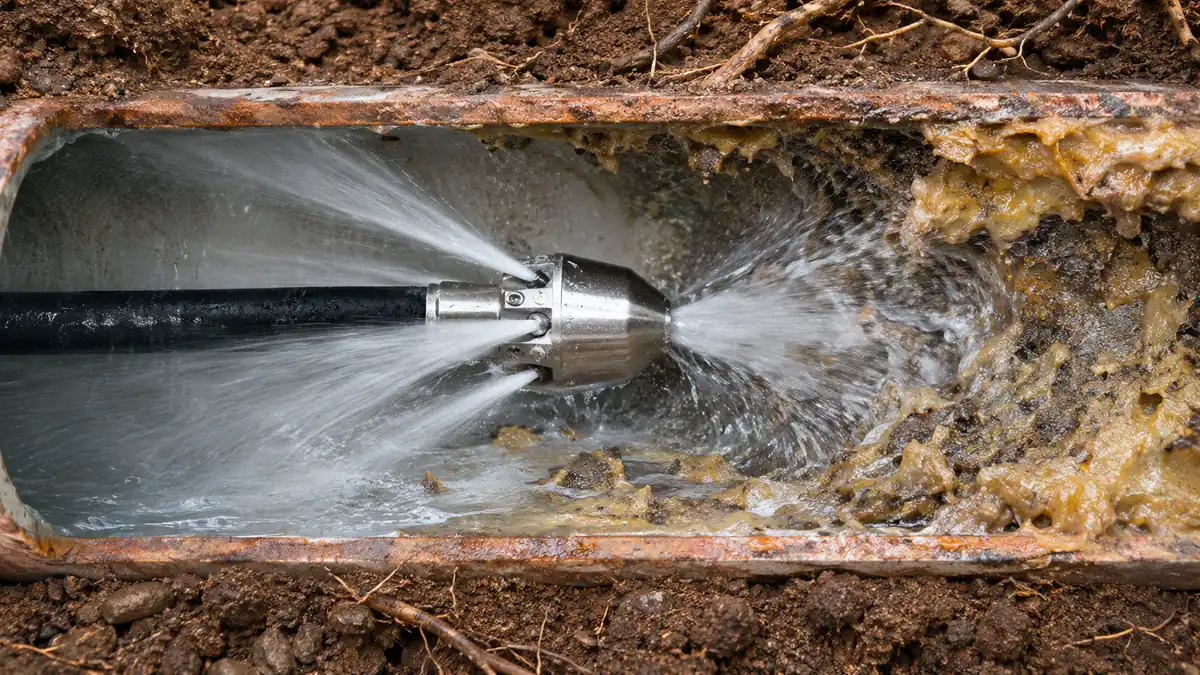
JEA runs the public mains and treatment, while the pipe that serves your building belongs on your side of the ledger. JEA's advice on its septic phase-out projects adds a practical order of operations: report the problem to JEA first, because JEA will investigate and fix anything on its side, and otherwise you call a plumber or drain professional. For a blockage on your side, sewer line jetting clears the pipe walls, and a camera inspection can show roots, buildup or breaks that may explain the clog. Call now to get information about the service and book a visit.
Why do Jacksonville's older neighborhoods need extra attention?
Because pipe age varies a lot across the city. Riverside, Avondale, Springfield and San Marco include homes built long before plastic pipe, while Southside and Mandarin subdivisions are newer.
Older clay and cast iron lines can crack or shift at joints, which lets roots in and catches grease. Jacksonville is also a very large city by land area, so a house on one side of town can have a very different pipe history from a house on the other. A camera run from the cleanout records the line's condition, which is useful before cleaning, after a backup, or when buying a home. JEA's septic tank phase-out projects are also bringing homes onto sewer in some neighborhoods, which means new connections that deserve a first look too.
Who maintains which part of the line in Jacksonville?
JEA's rules put the unobstructed flow of the building sewer on the owner. The table shows how the pieces line up.
| Part of the line | Who maintains it | What it means when a line clogs |
|---|---|---|
| Public sewer mains and treatment | JEA | Report a suspected main problem to JEA first |
| Building sewer serving your property | Property owner | JEA's rules make the owner responsible for keeping it flowing |
| Drains and fixtures inside the building | Property owner | Grease and wipes build up here first; jetting cleans the pipe walls |
What clogs sewer lines in Jacksonville?
Grease, wipes and tree roots are all possible causes. EPA's inspection manual names grease and tree roots as the primary causes of sewer blockages, and Jacksonville has restaurants and mature oaks in plenty.
Kitchens along King Street, in San Marco and near the Southbank add steady grease loads, and residential lines collect wipes that were never meant to be flushed. Where roots are the cause, tree root removal clears the line; where grease is building up, drain jetting and commercial grease line jetting wash it from the pipe walls.
Which hydro jetting services can you book in Jacksonville?
Every service on this site is available in Jacksonville, for a bungalow in Riverside, an apartment complex on the Southside or a restaurant on the river.
- Sewer line jetting for the building sewer between your cleanout and the connection
- Sewer camera inspection for older Riverside, Springfield and San Marco lines
- Tree root removal for lines reached by Jacksonville's mature oaks
- Drain jetting for kitchen, laundry and bath branches
- Commercial grease line jetting for restaurants, hotels and cafeterias
- Sewer backup help for a toilet, tub or floor drain that is overflowing
- Storm drain jetting for apartment lots, shopping centers and private catch basins
Neighborhoods and nearby cities
Calls come from across Jacksonville, including Riverside, Avondale, San Marco, Springfield, Mandarin, Arlington, Ortega, the Southside, Murray Hill and Baymeadows.
The closest local page is hydro jetting in Orlando. Help is also available in Orange Park, Fleming Island, Ponte Vedra Beach, Atlantic Beach, Neptune Beach, Jacksonville Beach, Fernandina Beach, Green Cove Springs and Middleburg. See the Florida page for every city we cover.